Technical documentation

1 - Principle
DMI dehydrator processes the waste on site,directly connected from theharvesting area, without necessary intermediary storage, and transforms a liquid waste into a safe,clean, and easily transportable…
2 - Process Flow Sheet
The system is composed of a dehydration tank with a horizontal mixing shaft. Three loading inlets located on the top of the tank allow an easy loading of the Egg Waste following the flow generated by the harvesters. The loading is controlled by the system automatism which does or doesn’t authorize the filling operation, depending on the type of loading cycle selected at the beginning of the harvesting campaign. The product level in the dehydrator is controlled by a level sensor based on radar technology and eventually by calculation of the quantity of Egg Waste transferred to the dehydrator by using a flow meter or impulses given by the harvesters or by the transfer station. During the dehydration phase, the process is completely automatic. The mixing shaft continuously blends the product. Fresh air enters the dehydration tank above the waste through a valve and a heat exchanger. Fresh air, vapors and gases emitted from the warmer product are sucked through a ductwork system by a turbo fan into the thermal oxidation chamber where they are burned, then no contaminated air residues will be released into atmosphere. The hot air produced by the burner in the oxidation chamber, if necessary, is lightly cooled by fresh air before it is circulated through the double jacket around the dehydration tank, then up through the heat exchanger, and finally through the exhaust fan and chimney. The process creates a slight depression/ negative pressure in the dehydration tank. After a request by the operator on the control process and in some conditions, the visit trap-doors located on the top of the unit may be opened for a short period to see the inside of the dehydration tank during the treatment. When a timer reached the preset dehydration cycle duration, corresponding to a level of preset treatment, the heat production provided by the burner is stopped automatically (the operator can also manually stop the heating process). The circulation of fresh air allows the progressive cooling of the unit as well as of the treated product. When the cycle is complete, the system stops automatically. To discharge the treated product, the operator opens the discharging door located on a side of the dehydration tank, installs the safety guard to protect the personnel, and activates the startup of the unloading cycle. At this stage, the mixing shaft is set into reverse rotation, which forces the treated product through the discharging door.As a result, there is no special cleaning of the tank before proceeding to a new loading cycle.
3- Process in four steps

1 - LOADING

Loading inlet pipes and visit traps are located on the top of the unit. The contaminated product is easily loaded by pumping which can be done directly along the harvesting process or directly from an intermediate transfert skid.

The vaccine growth medium doesn't need to be deactivated first.

 The dehydrator includes a pre-heating system which allows the unit to reach the nominal working temperature before loading the vaccine growth medium.

2 - TREATMENT CYCLE

The operator can begin the cycle from the touch screen terminal on the unit or via a "SCADA"1 system.

From this point onwards the processing is completely automatic :

* The mixing shaft (3) rotates the product.

* Fresh air (12) enters through the heat exchanger into the airspace (7) above the product in the dehydration tank.

* Fresh air, vapors and gases emitted from the product are sucked through a ductwork system (8) by a turbo fan (9) into the combustion chamber (10) where they are then burned at high temperature.

* Odors and bio-hazards are broken down and removed.

* The hot air produced by the burner (5) is circulated through the double jacket (6) then up through the heat exchanger, and finally through the exhaust fan (13) and chimney.

* When the product reaches the preset level of dryness, the burner flame will automatically cease and the circulating fresh air will cool down the overall equipment and product.

* When the cycle is complete, the unit stops automatically.

3 - UNLOADING

To unload the dehydrator, the operator simply opens the outlet door, puts in the body protection and turns on the unloading cycle.

The mixing shaft is set into reverse rotation, which forces the treated product through the outlet door.

No special cleaning or preparation is needed to begin processing the next load.
 

4 - Output

4- Commissioning

The commissioning is done by DMI’s teams or it’s representative.

As most of the elements supplied by DMI are skid-packaged, the commissioning is easy and very time efficient (the machine will be made operational in a matter of days).

In addition, the client’s staff will be trained in the use and in the maintenance of the equipment during the commissioning.
5- Standard testing

The FAT (Factory Acceptance Test) is performed at the DMI’s facility under supervision of the client. The object of this test is to check the compliance of the equipment with the client’s design specifications prior shipping.

The SAT (Site Acceptance Test) is performed at the client’s site after commissionning. The object of this test is to check that the equipment fulfills all the specifications of the contract. At the end of the SAT, the client will be provided with an IQ-OQ allowing the client to prove the conformity of his operations. At the end of the SAT, the client will be provided with a document containing all the elements required to validate the IQ-OQ, including the proof of the client’s staff’s (operators and maintenance) training.

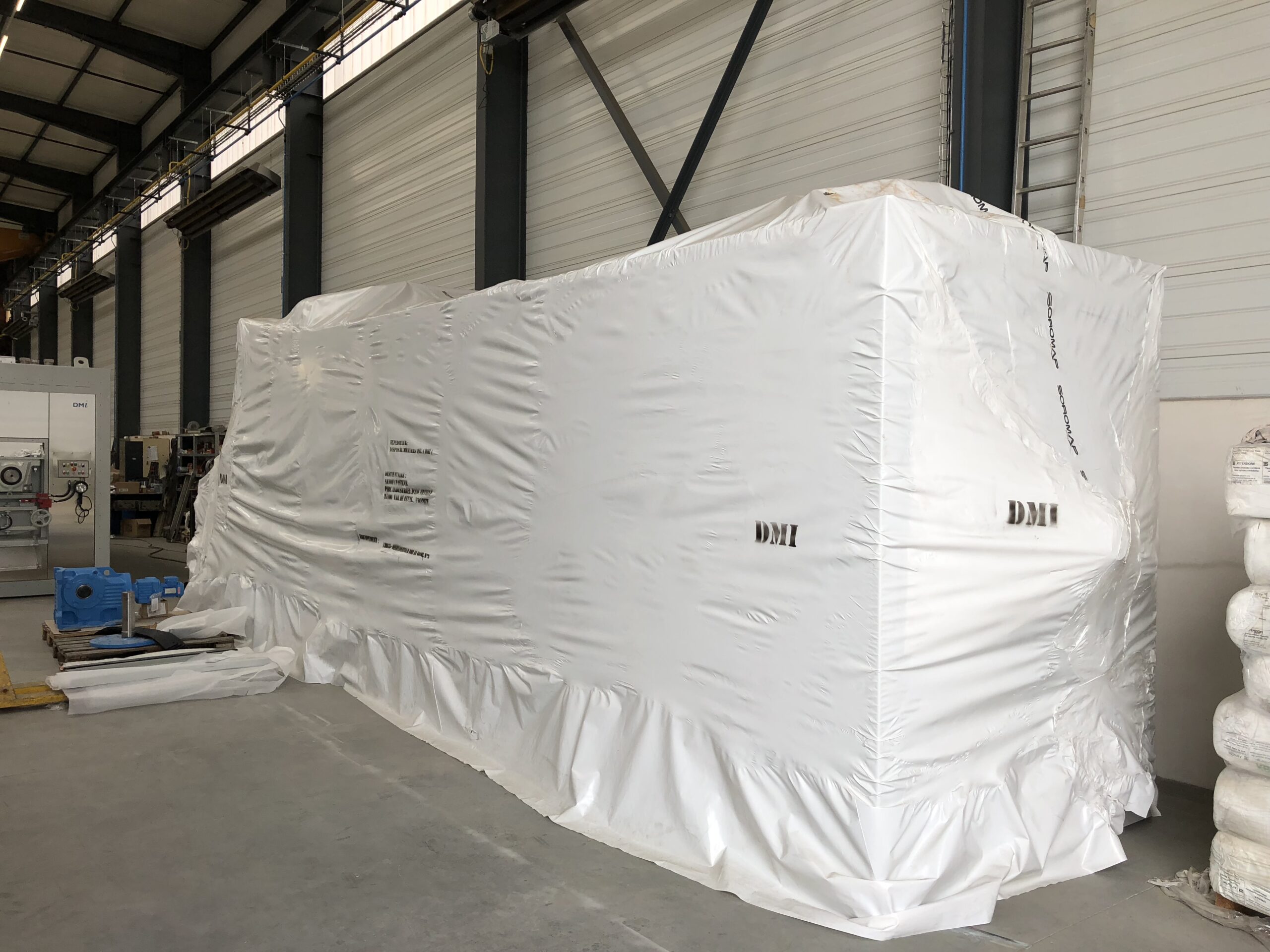
6 - Transportation

PACKING :
7 - Technical data

Our Dehydrators

Capacity

Processed volume per batch

Estimated number of processed eggs per batch

Time per batch

Time to download after process

Dehydrator AV500L

500 liters

10000 eggs

5 to 7 hours

10 minutes

Dehydrator AV1500L

1700 liters

30000 eggs

10 to 14 hours

15 minutes

Dehydrator AV3000L

3800 liters

75000 eggs

12 to 15 hours

15 minutes

Dehydrator AV6000L

6800 liters

13000 eggs

12 to 17 hours

20 minutes